After hearing the work by Ali Rahbari, HALF MOON, it occurred to me that it will be quite a challenge to write a work which combines a Western symphony orchestra with an African instrumental group as apposed to choir.
In September 1984 I was commissioned by the Oude Meester Foundation for the Performing Arts to write such a work with Amampondo in mind. But when they were approached on the matter, they showed no interest. It was then that Andrew Tracey suggested that I should try out a group of Chopi players with whom he had contact.
In January 1985, I first went to Grahamstown to have discussions with Andrew, and from there, I went to the Wildebeestfontein North Mine near Rustenburg to meet the leader of the Chopi xylophone (timbila) orchestra, Venancio Mbande.
Originally, the Chopi hail from southern Mozambique and they are well-known for their music and for the very fine and powerful instruments they make.
The daunting task was to find common ground:
The first problem was the tuning of their instruments. As they divide the octave in 7 equal parts, there was no point in trying to adapt the Western instruments accordingly, and because I had in mind to use indefinite pitches such as very high or extremely low notes, or complex structures such as clusters, I soon realised that the discrepancy in tuning will actually enhance the music.
Secondly, because the Chopi do not read music, I was obliged to use one of their pieces of music with which they were familiar, and I had to device a form scheme in which they could play this music together with a symphony orchestra. The music that I decided to use in the end, is a Mtsitso which functions as an introduction to the MGODO
But the biggest headache was to find the "right" piece of music. It was Andrew Tracey who suggested a Mtsitso because of its clear structure and in fact he told me of a Mtsitso that was played for the chief at Kenge in Chopiland in 1973, where it was recorded for a film on the Chopi. At the time that I met Venancio, he could only play me short fragments that he remembered but his group did not know it at all. Only after obtaining a cassette copy of the 1973 recordings from the Traditional Music Documentation Project in Washington, was I able to hear this Mtsitso Kenge of Venancio played by a full ensemble and could I start with composition.
By this time I had read a lot about the Chopi and their tradition in the book by Hugh Tracey, Chopi Musicians. In the mean time, Venancio agreed to teach his group this particular song and it was only at the first rehearsal that we saw each other again.
Something about the Chopi timbila: The word "mbila" refers to a single key on the xylophone, likewise "timbila" is the plural. Indirectly "timbila" refers to the sound being made.
The instruments that they play, are made in three different sizes:
SANJE (tenor/baritone: ca. 19 keys)
DIBHINDA (baritone/bass: ca. 11 keys)
CHINZUMANA (double bass: 3-4 keys)
NJELE = a rattle.
Orchestras could comprise of 15-30, or even more instruments
The MGODO is akin to other organised social dancing in Africa and consists of 7 different movements (of which the Mtsitso is the first) and lasts for over an hour. Very often the songs address critical issues. For instance, the people do not criticise their chief directly, they do it through the music!
Apart from the fact that Venancio's Mtsitso Kenge contains a very simple "do-re-mi-do" motif, it has an ABC form. The A-section consists of a number of "short starts" which the leader opens and which is answered by the rest of the group in unison/octaves. In the B-section everyone is playing a cyclical pattern together, and in the C-section, the "do-re-mi-do" motif becomes a prominent feature of the whole group, marking as it does in this song, the end of every cycle. It is only the leader who now makes all sorts of excursions in an improvisatory manner. It is also interesting to note that this motif, has a significant function as a kind of signal device in the music of the Chopi.
The structure of the music offered by the Western orchestra, takes its cue from the Chopi music and one finds passages in strict metre interchanging with senza misura passages all the time. This procedure makes it possible for the orchestra to play colla parte with the Chopi and because of the very strong rhythmic impact of the latter, the senza misura is often not perceived as such by the listener. While the Chopi is busy with their B-section, the symphony orchestra tries to "impose" with the "do-re-mi-do" motif, and eventually they succeed in convincing the Chopi to follow suit. This is when the C-section starts. The orchestra now has floating material of which the texture gradually becomes louder and more dense.
What actually happens, is a double canon in the orchestra based on notes that one can pick out after repeated listening to the Chopi song. The "do-re-mi-do" motif leads as far as I am concerned, towards its logical conclusion in the rendering of Frére Jacques by the Horns playing it campana in aria whilst standing up.
After this "anthem" effect, references to the opening of the work, brings it to a gentle close.
TIMBILA, completed on 25 May 1985, was first performed at the Standard Bank National Arts Festival by the National Symphony Orchestra of the SABC, conducted by the American conductor, Christian Tiemeyer, and the Chopi xylophone orchestra from the Wildebeestfontein North Mine, leader Venancio Mbande, on 12 and 13 July 1985. The recording on the CD was made a week prior to these dates.
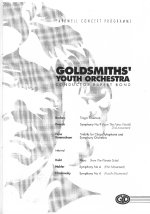
Apart from the performances Timbila had in Grahamstown, it was also done in Cape Town in 1986. In addition it was performed in London by the Goldsmiths' Youth Orchestra, conducted by Rupert Bond, on 25 September 1993.
Because there are no Chopi musicians in London as such, this performance combined the tape recording of the Chopi, made in 1973 in Mozambique, with the playing of the orchestra.
I am very much indebted to Andrew Tracey who encouraged and assisted me tremendously in this search. The work is dedicated to the Chopi, and especially to their leader/composer Venancio Mbande. Without their support, not even the faintest note in this adventure in sound could have been struck.
A final thought: Maybe I learnt from the Chopi not to criticise my "chief" directly, but rather, through the music!?
 As a whole, this fairly short work is a gripping experience, mainly because Roosenschoon found a coherent element which joined the diverse forces rather than bringing them in conflict with one another.
(Odendaal, Thys. 18 July 1985, BEELD)
Roosenschoon's music achieves a remarkable synthesis, which in effect is quite individual. While certain parameters of the music apply avant-garde techniques, others are often treated in a more conventional way. For instance, within a highly dissonant texture the composer might use a conventional melodic element. This juxtaposition of new and traditional elements helps to make Roosenschoon's music accessible to the average listener, an accessibility often further enhanced through the quotation of familiar melodic material such as his use of "Frere Jacques" in Timbila.
Of the African-inspired works, Timbila is probably Roosenschoon's masterpiece. The composer sees the work as a fusion of traditional African 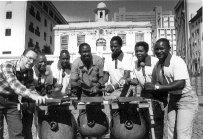 music played on original instruments and the timbre-texture writing of his earlier orchestral pieces. The Chopi, from Southern Mozambique, are well-known for their xylophones (timbila), which they combine into large orchestras. A rising tonic-mediant motive is used as a unifying element throughout the work. At the climax of the piece this is expanded into the quotation of "Frere Jacques". However the listener might perceive these African works, they incorporate all of Roosenschoon's best qualities: an innate sense of structure, rhythmic interest, sensitivity to colouristic effect and a strong lyric tendency.
(May, James. 1992. HANS ROOSENSCHOON in Morton, Brian & Collins, Pamela (ed.), CONTEMPORARY COMPOSERS, St James Press, Chicago & London)
Van Wyk, Barbara. 13 July 1985, EASTERN PROVINCE HERALD
Kooij, Pieter. 7 April 1986, DIE BURGER
Irish, Deon. 5 April 1986, CAPE TIMES
Cloete, Johan. 7 April 1986, THE ARGUS